
21년 11월 고2 교육청

c_title
1_out_of_5

1. $\tan \frac{10}{3}\pi$의 값은? [2점]

① $\frac{1}{3}$
② $\frac{\sqrt{3}}{3}$
③ $1$
④ $\sqrt{3}$
⑤ $3$

$\tan \frac{10}{3}\pi$ $= \tan (3 \pi + \frac{\pi}{3}) = \tan \frac{\pi}{3} = \sqrt{3}$

2. $\log_{3}18-\log_{3}2$의 값은? [2점]

① $1$
② $2$
③ $3$
④ $4$
⑤ $5$

$\log_{3}18-\log_{3}2$ $= \log_{3}\frac{18}{2} = \log_{3}9 = 2$

3. 함수 $f(x) = x^{3}+3x+1$에 대하여 $f'(1)$의 값은? [2점]

① $2$
② $4$
③ $6$
④ $8$
⑤ $10$

$f'(x) = 3x^{2}+3$에서 $f'(1) = 3+3 = 6$

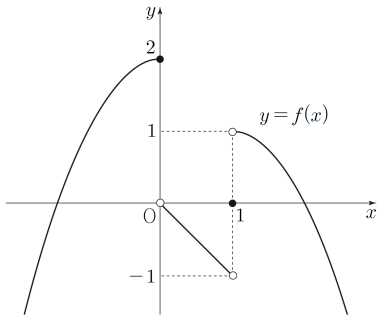
4.함수 $y = f(x)$의 그래프가 그림과 같다.

22111_c04_1

$\displaystyle \lim_{x \to 0-}f(x) \times \lim_{x \to 1+}f(x)$의 값은? [3점]

① $-2$
② $-1$
③ $0$
④ $1$
⑤ $2$

$\displaystyle \lim_{x \to 0-}f(x) \times \lim_{x \to 1+}f(x)$ $= 2 \times 1 = 2$

5.부등식 $\left( \dfrac{1}{3} \right)^{x-7} \ge 9\,$를 만족시키는 모든 자연수 $x$의 개수는? [3점]

① $4$
② $5$
③ $6$
④ $7$
⑤ $8$

$( \frac{1}{3} )^{x-7} \ge 9$, $( \frac{1}{3} )^{x-7} \ge ( \frac{1}{3} )^{-2}$에서
밑 $\frac{1}{3}$이 $1$ 보다 작으므로 $x-7 \le -2$, $x \le 5$
따라서 모든 자연수 $x$의 개수는 $5$

6. 두 수열 $\{ a_n \}$, $\{ b_n \}$에 대하여 $\displaystyle \sum_{k=1}^{10}a_{k} = 5$, $\displaystyle \sum_{k=1}^{10}b_{k} = 20$일 때, $\displaystyle \sum_{k=1}^{10}(a_{k}+2b_{k}-1)$의 값은? [3점]

① $25$
② $30$
③ $35$
④ $40$
⑤ $45$

$\begin{align} \displaystyle \sum_{k=1}^{10}(a_{k}+2b_{k}-1) &= \sum_{k=1}^{10}a_{k}+2\sum_{k=1}^{10}b_{k}-\sum_{k=1}^{10}1 \\ &= 5+2\times 20-1\times 10 \\ &= 35 \end{align}$

7. 함수 $f(x) = x^{3}+x^{2}-2x$에서 $x$의 값이 $0$에서 $k$까지 변할 때의 평균변화율이 $10$일 때, 양수 $k$의 값은? [3점]

① $3$
② $\frac{7}{2}$
③ $4$
④ $\frac{9}{2}$
⑤ $5$

함수 $f(x) = x^{3}+x^{2}-2x$에서 $x$의 값이 $0$에서 $k$까지 변할 때의 평균변화율은
$\frac{f(k)-f(0)}{k-0} = \frac{(k^{3}+k^{2}-2k)-0}{k-0} = k^{2}+k-2$
$k^{2}+k-2 = 10$
$(k+4)(k-3) = 0$에서 $k = -4$ 또는 $k = 3$
따라서 양수 $k$의 값은 $3$

8. $1$이 아닌 양수 $a$에 대하여 $\log_{2}3 \times \log_{a}4 = \dfrac{1}{2}$일 때, $\log_{3}a$의 값은? [3점]

① $2$
② $\frac{5}{2}$
③ $3$
④ $\frac{7}{2}$
⑤ $4$

$\log_{2}3 \times \log_{a}4 = \frac{1}{\log_{3}2} \times \frac{2\log_{3}2}{\log_{3}a} = \frac{2}{\log_{3}a} $이므로
$\frac{2}{\log_{3}a} = \frac{1}{2}$에서 $\log_{3}a = 4$

9. 닫힌구간 $[1, 3]$에서 정의된 함수 $f(x) = \bigg( \dfrac{1}{2}\bigg)^{x-a}+1\,$의 최댓값이 $5$일 때, 함수 $f(x)$의 최솟값은? (단, $a$는 상수이다.) [3점]

① $\frac{3}{2}$
② $2$
③ $\frac{5}{2}$
④ $3$
⑤ $\frac{7}{2}$

닫힌구간 $[1, 3]$에서 함수 $f(x) = (\frac{1}{2})^{x-a}+1$은 $x$의 값이 증가하면 $y$의 값은 감소한다.
그러므로 함수 $f(x)$는 $x=1$에서 최댓값 $5$를 갖는다.
$(\frac{1}{2})^{1-a}+1 = 5$에서 $2^{a-1} = 2^{2}$, $a = 3$
함수 $f(x)$는 $x = 3$에서 최솟값을 가지므로구하는 최솟값은
$f(3) = (\frac{1}{2})^{3-3}+1 = 2$

10. 좌표평면 위의 점 $\mathrm{P}(4, -3)$에 대하여 동경 $\mathrm{OP}$가 나타내는 각의 크기를 $\theta$라 할 때, $\sin \bigg( \dfrac{\pi}{2}+\theta\bigg)-\sin \theta$의 값은?
(단, $\mathrm{O}$는 원점이고, $x$축의 양의 방향을 시초선으로 한다.) [3점]

① $-1$
② $-\frac{2}{5}$
③ $\frac{1}{5}$
④ $\frac{4}{5}$
⑤ $\frac{7}{5}$

$\sin \theta = \frac{-3}{\sqrt{4^{2}+(-3)^{2}}} = -\frac{3}{5}$
$\cos \theta = \frac{4}{\sqrt{4^{2}+(-3)^{2}}} = \frac{4}{5}$이므로
$\sin ( \frac{\pi}{2}+\theta )-\sin \theta = \cos \theta-\sin \theta = \dfrac{7}{5}$

11. 두 상수 $a$, $b$에 대하여 함수 $f(x) = 4 \cos \dfrac{\pi}{a}x + b$의 주기가 $4$이고 최솟값이 $-1$일 때, $a+b$의 값은? (단, ) [3점]

① $5$
② $7$
③ $9$
④ $11$
⑤ $13$

함수 $f(x) = 4 \cos \frac{\pi}{a}x + b$의 주기가 $4$이므로
$\dfrac{2 \pi}{|\frac{\pi}{a}|} = 4$
$a \gt 0$이므로 $a = 2$
함수 $f(x)$의 최솟값이 $-1$이므로
$-4+b = -1$에서 $b = 3$
따라서 $a+b = 5$

12. 함수 $$f(x) = \begin{cases} x^{3} -ax+2b & (x \lt 1) \\ -3x+b & (x \ge 1) \end{cases}$$ 이 실수 전체의 집합에서 미분가능할 때, $a \times b$의 값은? (단, $a$와 $b$는 상수이다.) [3점]

① $3$
② $6$
③ $9$
④ $12$
⑤ $15$

함수 $f(x)$가 실수 전체의 집합에서 미분가능하므로 함수 $f(x)$는 $x=1$에서 미분가능하다.
그러므로 함수 $f(x)$는 $x=1$에서 연속이다.
$\displaystyle \lim_{x \to 1-}f(x) = \lim_{x \to 1+}f(x) = f(1)$에서
$1-a+2b = -3+b$
$b = a-4$
$\begin{align} \displaystyle \lim_{x \to 1-}\frac{f(x)-f(1)}{x-1} &= \lim_{x \to 1-}\frac{(x^{3} -ax+2b)-(-3+b)}{x-1} \\ &= \lim_{x \to 1-}\frac{x^{3} -ax+a-1}{x-1} \\ &= \lim_{x \to 1-}(x^{2}+x+1-a) \\ &= 3-a \end{align}$
$\begin{align} \displaystyle \lim_{x \to 1+}\frac{f(x)-f(1)}{x-1} &= \lim_{x \to 1+}\frac{(-3x+b)-(-3+b)}{x-1} \\ &= \lim_{x \to 1+}\frac{-3x+3}{x-1} \\ &= -3 \end{align}$
함수 $f(x)$가 $x=1$에서 미분가능하므로
$3-a = -3$에서 $a=6$이고 $b=2$
따라서 $a \times b = 12$

13. $0$이 아닌 모든 실수 $x$에 대하여 함수 $f(x)$가 $$\dfrac{1}{2}x^{2}+2x \lt f(x) \lt x^{2}+2x$$ 를 만족시킬 때, $\displaystyle \lim_{x \to 0}\frac{xf(x)+5x}{2f(x)-x}$의 값은? [3점]

① $\frac{5}{3}$
② $2$
③ $\frac{7}{3}$
④ $\frac{8}{3}$
⑤ $3$

(ⅰ) 부등식 $\frac{1}{2}x^{2}+2x \lt f(x) \lt x^{2}+2x$에서
$\displaystyle \lim_{x \to 0}$$(\frac{1}{2}x^{2}+2x) = \displaystyle \lim_{x \to 0}(x^{2}+2x) = 0$이므로
함수의 극한의 대소 관계에 의해 $\displaystyle \lim_{x \to 0}f(x) = 0$

(ⅱ) $x \gt 0$일 때, $\frac{1}{2}x+2 \lt f(x) \lt x+2$이고
$\displaystyle \lim_{x \to 0+}$$(\frac{1}{2}x+2) = \displaystyle \lim_{x \to 0+}(x+2) = 2$이므로
함수의 극한의 대소 관계에 의해 $\displaystyle \lim_{x \to 0+}$$\frac{f(x)}{x} = 2$
$x \lt 0$일 때, $x+2 \lt f(x) \lt \frac{1}{2}x+2$이고
$\displaystyle \lim_{x \to 0-}(x+2) =\lim_{x \to 0-}$$(\frac{1}{2}x+2) = 2$이므로
함수의 극한의 대소 관계에 의해 $\displaystyle \lim_{x \to 0-}$$\frac{f(x)}{x} = 2$
$\displaystyle \lim_{x \to 0+}$$\frac{f(x)}{x} = \displaystyle \lim_{x \to 0-}$$\frac{f(x)}{x} = 2$이므로 $\displaystyle \lim_{x \to 0}\frac{f(x)}{x} = 2$

(ⅰ), (ⅱ)에 의해
$\begin{align} \displaystyle \lim_{x \to 0}\frac{xf(x)+5x}{2f(x)-x} &= \lim_{x \to 0}\frac{f(x)+5}{2\times \frac{f(x)}{x}-1} \\ &= \lim_{x \to 0}\frac{0+5}{2\times 2-1} = \frac{5}{3} \end{align}$

14. 모든 항이 양수인 등비수열 $\{ a_n \}$의 첫째항부터 제$n$항까지의 합을 $S_n$이라 하자. $$a_{1} = 3, \:\frac{S_{6}}{S_{5}-S_{2}} = \frac{a_{2}}{2}$$ 일 때, $a_{4}$의 값은? [4점]

① $6$
② $9$
③ $12$
④ $15$
⑤ $18$

등비수열 $\{ a_n \}$의 공비를 $r$ ($r \gt 0$)이라 하자.
$r = 1$이면
$\frac{S_{6}}{S_{5}-S_{2}} = \frac{3\times 6}{3\times 5-3\times 2} = 2$, $\frac{a_{2}}{2} = \frac{3}{2}$에서
$\frac{S_{6}}{S_{5}-S_{2}} = \frac{a_{2}}{2}$가 성립하지 않으므로 $r \ne 1$
$\begin{align} \frac{S_{6}}{S_{5}-S_{2}} &= \frac{ \frac{3(r^{6}-1)}{r-1} }{\frac{3(r^{5}-1)}{r-1}-\frac{3(r^{2}-1)}{r-1}} \\ &= \frac{r^{6}-1}{r^{5}-r^{2}} \\ &= \frac{(r^{3}+1)(r^{3}-1)}{r^{2}(r^{3}-1)} \\ &= \frac{r^{3}+1}{r^{2}} \end{align}$
$\dfrac{a_2}{2} = \dfrac{3r}{2}$이므로
$\displaystyle \frac{r^{3}+1}{r^{2}} = \frac{3r}{2}$에서 $2(r^{3}+1) = 3r^{3}$, $r^{3} = 2$
따라서 $a_{4} = ar^{3} = 3 \times 2 = 6$

15. 두 다항함수 $f(x)$, $g(x)$가 $$\lim_{x \to 1}\frac{f(x)-a+2}{x-1} = 4, \: \lim_{x \to 1}\frac{g(x)+a-2}{x-1} = a$$ 를 만족시킨다. 함수 $f(x)g(x)$의 $x=1$에서의 미분계수가 $-1$일때, 상수 $a$의 값은? [4점]

① $1$
② $2$
③ $3$
④ $4$
⑤ $5$

$\displaystyle \lim_{x \to 1}\frac{f(x)-a+2}{x-1} = 4$이고 $\displaystyle \lim_{x \to 1}(x-1) = 0$이므로
$\displaystyle \lim_{x \to 1}\{f(x)-a+2\} = 0$
함수 $f(x)$는 다항함수이므로
$\displaystyle \lim_{x \to 1}f(x) = f(1) = a-2$
$\displaystyle \lim_{x \to 1}\frac{f(x)-a+2}{x-1} = \lim_{x \to 1}\frac{f(x)-f(1)}{x-1} = f'(1) = 4$

$\displaystyle \lim_{x \to 1}\frac{g(x)+a-2}{x-1} = a$이고 $\displaystyle \lim_{x \to 1}(x-1) = 0$이므로
$\displaystyle \lim_{x \to 1}\{g(x)+a-2\} = 0$
함수 $g(x)$는 다항함수이므로
$\displaystyle \lim_{x \to 1}g(x) = g(1) = -a+2$
$\displaystyle \lim_{x \to 1}\frac{g(x)+a-2}{x-1} = \lim_{x \to 1}\frac{g(x)-g(1)}{x-1} = g'(1) = a$

함수 $f(x)g(x)$의 $x=1$에서의 미분계수는
$\begin{align} f'(1)g(1)+f(1)g'(1) &= 4\times (-a+2)+(a-2)\times a \\ &= a^{2}-6a+8 = -1 \end{align}$
$a^{2}-6a+9 = 0$에서 $(a-3)^{2} = 0$
따라서 $a=3$

16. $\frac{\pi}{2} \lt \theta \lt \pi$인 $\theta$에 대하여 $\sin^{4} \theta + \cos^{4} \theta = \dfrac{23}{32}$일 때, $\sin \theta-\cos \theta$의 값은? [4점]

① $\frac{\sqrt{3}}{2}$
② $1$
③ $\frac{\sqrt{5}}{2}$
④ $\frac{\sqrt{6}}{2}$
⑤ $\frac{\sqrt{7}}{2}$

$\begin{align}\sin^{4} \theta + \cos^{4} \theta &= (\sin^{2} \theta + \cos^{2})^{2}-2\sin^{2} \theta \cos^{2}\theta \\ &= 1-2\sin^{2} \theta \cos^{2}\theta = \frac{23}{32} \end{align}$
에서 $\sin^{2} \theta \cos^{2} \theta = \frac{9}{64}$
$\frac{\pi}{2} \lt \theta \lt \pi$에서 $\sin \theta \gt 0$, $\cos \theta \lt 0$이므로
$\sin \theta \cos \theta = -\frac{3}{8}$

$(\sin \theta-\cos \theta)^{2} = 1-2\sin \theta \cos \theta = \frac{7}{4}$
따라서 $\sin \theta-\cos \theta = \dfrac{\sqrt{7}}{2}$

17. $2$ 이상의 자연수 $n$에 대하여 $2^{n-3}-8$의 $n\,$제곱근 중 실수인 것의 개수를 $f(n)$이라 할 때, $\displaystyle \sum_{n = 2}^{m}f(n) = 15$가 되도록 하는 자연수 $m$의 값은? [4점]

① $12$
② $14$
③ $16$
④ $18$
⑤ $20$

$2 \le n \le 5$일 때, $2^{n-3}-8 \lt 0$이므로
$f(n) = \begin{cases} 1 & (n \text{은 홀수}) \\ 0 & (n \text{은 짝수}) \end{cases}$

$n = 6$일 때, $2^{6-3}-8 = 0$이므로
$f(6) = 1$

$\displaystyle \sum_{n = 2}^{6}f(n) = 0+1+0+1+1 = 3 \lt 15$이므로 $m \ge 7$

$n \ge 7$일 때, $2^{n-3}-8 \gt 0$이므로
$f(n) = \begin{cases} 1 & (n \text{은 홀수}) \\ 2 & (n \text{은 짝수}) \end{cases}$

그러므로 $f(7) = 1$, $f(8) = 2$, $f(9) = 1$, $f(10) = 2$, $f(11) = 1$, $f(12) = 2$, $f(13) = 1$, $f(14) = 2$에서
$\displaystyle \sum_{n = 2}^{m}f(n) = \sum_{n = 2}^{6}f(n)+\sum_{n = 7}^{14}f(n) = 3+12 = 15$
한편 $l \ge 15$인 자연수 $l$에 대하여 $f(l) \ge 1$이므로 $\displaystyle \sum_{n = 2}^{l}f(n) \gt 15$
따라서 $m = 14$

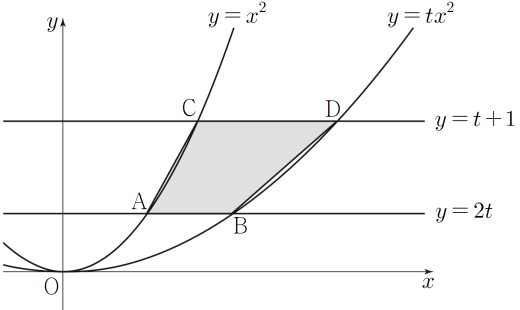
18. 그림과 같이 실수 $t$ ($0 \lt t \lt 1$)에 대하여 직선 $y = 2t$가 두 곡선 $y = x^{2}$, $y = tx^{2}$과 제$1$사분면에서 만나는 점을 각각 $\mathrm{A}$, $\mathrm{B}$라 하고, 직선 $y = t+1$이 두 곡선 $y = x^{2}$, $y = tx^{2}$과 제$1$사분면에서 만나는 점을 각각 $\mathrm{C}$, $\mathrm{D}$라 하자.
사각형 $\mathrm{ABCD}$의 넓이를 $S(t)$라 할 때, $\displaystyle \lim_{t \to 1-}\frac{S(t)}{(1-t)^{2}}$의 값은? [4점]

22111_c18_1

① $\frac{1}{4}$
② $\frac{\sqrt{2}}{4}$
③ $\frac{1}{2}$
④ $\frac{\sqrt{2}}{2}$
⑤ $1$

네 점 $\mathrm{A}$, $\mathrm{B}$, $\mathrm{C}$, $\mathrm{D}$의 좌표는 각각 $\mathrm{A}(\sqrt{2t}, 2t)$, $\mathrm{B}(\sqrt{2}, 2t)$, $\mathrm{C}(\sqrt{t+1}, t+1)$, $\mathrm{D}(\sqrt{ \frac{t+1}{t}}, t+1)$이므로
$\overline{\mathrm{AB}} = \sqrt{2}-\sqrt{2t} = \sqrt{2}(1-\sqrt{t})$
$\overline{\mathrm{CD}} = \sqrt{\frac{t+1}{t}}-\sqrt{t+1} = \sqrt{\frac{t+1}{t}}(1-\sqrt{t})$
점 $\mathrm{C}$에서 직선 $\mathrm{AB}$에 내린 수선의 발을 $\mathrm{H}$라 하면
$\overline{\mathrm{CH}} = (t+1)-2t = 1-t$이므로
$\begin{align} S(t) &= \frac{1}{2}\times (\overline{\mathrm{AB}}+\overline{\mathrm{CD}})\times \overline{\mathrm{CH}} \\ &= \frac{1}{2}\{ \sqrt{2}(1-\sqrt{t})+\sqrt{\frac{t+1}{t}}(1-\sqrt{t}) \}(1-t) \\ &= \frac{1}{2}\bigg( \sqrt{2}+ \sqrt{\frac{t+1}{t}}\bigg)(1-\sqrt{t})(1-t) \end{align}$
따라서
$\begin{align} \displaystyle \lim_{t \to 1-}\frac{S(t)}{(1-t)^{2}} &= \lim_{t \to 1-}\frac{1}{2(1+\sqrt{t})}\bigg( \sqrt{2}+ \sqrt{\frac{t+1}{t}} \bigg) \\ &= \frac{1}{4}\times 2\sqrt{2} = \frac{\sqrt{2}}{2} \end{align}$

19. 다음은 수열 $\{ a_n \}$이 모든 자연수 $n$에 대하여 $$\sum_{k=1}^{n}\bigg( \frac{1}{k}-\frac{1}{n+1} \bigg)a_{k} = n^{2}$$ 을 만족시킬 때, $\displaystyle \sum_{k=1}^{n}a_{k}$를 구하는 과정이다.

$\displaystyle T_{n} = \sum_{k=1}^{n}\bigg( \frac{1}{k}-\frac{1}{n+1} \bigg)a_{k}$라 하자.
(ⅰ) $T_{1} = 1$이므로 $a_{1} = \fbox{ $\textbf{(가)}$ }$이다.
(ⅱ) $2$ 이상의 자연수 $n$에 대하여
$T_{n} = n^{2}$에서
$T_{n}-T_{n-1} = 2n-1$이고
$T_{n} = \displaystyle \sum_{k=1}^{n}\frac{a_{k}}{k}-\frac{1}{\fbox{ $\textbf{(나)}$ }}\times \sum_{k=1}^{n}a_{k}$에서
$T_{n}-T_{n-1} = \displaystyle \frac{1}{\fbox{ $\textbf{(다)}$ }} \times \sum_{k=1}^{n}a_{k}$이므로
$\displaystyle \sum_{k=1}^{n}a_{k} = (2n-1)\times (\,\fbox{ $\textbf{(다)}$ }\,)$이다.
(ⅰ), (ⅱ)에 의하여 모든 자연수 $n$에 대하여
$\displaystyle \sum_{k=1}^{n}a_{k} = (2n-1)\times (\,\fbox{ $\textbf{(다)}$ }\,)$

(가)에 알맞은 수를 $p$, (나), (다)에 알맞은 식을 각각 $f(n)$, $g(n)$이라 할 때, $f(2p) \times g(3p)$의 값은? [4점]

① $190$
② $200$
③ $210$
④ $220$
⑤ $230$

$\displaystyle T_{n} = \sum_{k=1}^{n}\bigg( \frac{1}{k}-\frac{1}{n+1} \bigg)a_{k}$라 하자.
(ⅰ) $T_{1} = (1-\frac{1}{2})a_{1} = 1$이므로 $a_{1} = \fbox{ $2$ }$
(ⅱ) $2$ 이상의 자연수 $n$에 대하여
$T_{n} = n^{2}$에서
$T_{n}-T_{n-1} = n^{2}-(n-1)^{2} = 2n-1$이고
$\begin{align}T_{n} &= \sum_{k=1}^{n}\bigg( \frac{1}{k}-\frac{1}{n+1} \bigg)a_{k} \\ &= \sum_{k=1}^{n}\frac{a_{k}}{k}-\sum_{k=1}^{n}\frac{a_{k}}{n+1} \\ &= \sum_{k=1}^{n}\frac{a_{k}}{k}-\frac{1}{\fbox{ $n+1$ }}\times \sum_{k=1}^{n}a_{k} \end{align}$
$\begin{align}T_{n}&-T_{n-1} \\ &= \bigg( \sum_{k=1}^{n}\frac{a_{k}}{k}-\frac{1}{n+1}\times \sum_{k=1}^{n}a_{k} \bigg)-\bigg( \sum_{k=1}^{n-1}\frac{a_{k}}{k}-\frac{1}{n}\times \sum_{k=1}^{n-1}a_{k} \bigg) \\ &= \frac{a_{n}}{n}-\frac{1}{n+1}\sum_{k=1}^{n}a_{k}+\frac{1}{n}\sum_{k=1}^{n-1}a_{k} \\ &= -\frac{1}{n+1}\sum_{k=1}^{n}a_{k}+\frac{1}{n}\sum_{k=1}^{n}a_{k} \\ &= \bigg( \frac{1}{n}-\frac{1}{n+1} \bigg)\sum_{k=1}^{n}a_{k} \\ &= \frac{1}{\fbox{ $n(n+1)$ }} \times \sum_{k=1}^{n}a_{k} = 2n-1\end{align}$ <br>
이므로 <br>
$\displaystyle \sum_{k=1}^{n}a_{k} = (2n-1)\times (\,\fbox{ $n(n+1)$ }\,)$이다. <br>
(ⅰ), (ⅱ)에 의하여 모든 자연수 $n$에 대하여 <br>
$\displaystyle \sum_{k=1}^{n}a_{k} = (2n-1)\times (\,\fbox{ $n(n+1)$ }\,)$이다.

따라서 $p = 2$, $f(n) = n+1$, $g(n) = n(n+1)$이므로
$f(2p) \times g(3p) = f(4) \times g(6) = 5 \times 42 = 210$

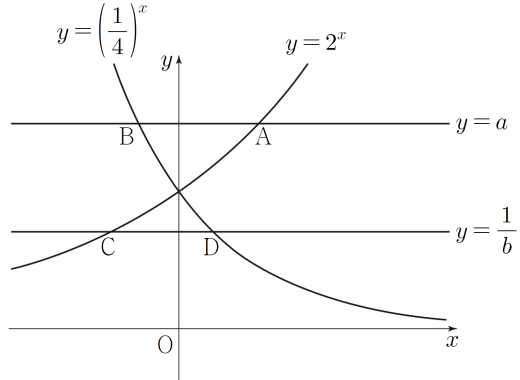
20. 그림과 같이 $1$ 보다 큰 두 실수 $a$, $b$에 대하여 직선 $y=a$가 두 곡선 $y = 2^{x}$, $y = \bigg( \dfrac{1}{4}\bigg)^{x}$과 만나는 점을 각각 $\mathrm{A}$, $\mathrm{B}$라 하고, 직선 $y=\dfrac{1}{b}$이 두 곡선 $y = 2^{x}$, $y = \bigg( \dfrac{1}{4}\bigg)^{x}$과 만나는 점을 각각 $\mathrm{C}$, $\mathrm{D}$라 하자. <보기>에서 옳은 것만을 있는 대로 고른 것은? [4점]

22111_c20_1

ㄱ. $a=b$이면 $\overline{\mathrm{AB}} = \overline{\mathrm{CD}}$이다.
ㄴ. 직선 $\mathrm{AC}$의 기울기를 $m_1$, 직선 $\mathrm{BD}$의 기울기를 $m_2$라 하면 $2m_{1}+m_{2} = 0$이다.
ㄷ. 직선 $\mathrm{AC}$와 직선 $\mathrm{BD}$가 서로 수직이고 직선 $\mathrm{AD}$의 기울기가 $$2\sqrt{2}이면 사각형 $\mathrm{ABCD}$는 마름모이다.

① ㄱ
② ㄷ
③ ㄱ, ㄴ
④ ㄴ, ㄷ
⑤ ㄱ, ㄴ, ㄷ

네 점 $\mathrm{A}$, $\mathrm{B}$, $\mathrm{C}$, $\mathrm{D}$의 좌표는 각각 $\mathrm{A}(\log_{2}a, a)$, $\mathrm{B}(\log_{\frac{1}{4}}a, a)$, $\mathrm{C}(\log_{2}\frac{1}{b}, \frac{1}{b})$, $\mathrm{D}(\log_{\frac{1}{4}}\frac{1}{b}, \frac{1}{b})$이다.

ㄱ.
$a = b$이면
$\overline{\mathrm{AB}} = \log_{2}a-\log_{\frac{1}{4}}a = \frac{3}{2}\log_{2}a$
$\overline{\mathrm{CD}} = \log_{\frac{1}{4}}\frac{1}{a}-\log_{2}\frac{1}{a} = \frac{3}{2}\log_{2}a$
이므로 $\overline{\mathrm{AB}} = \overline{\mathrm{CD}}$ (참)

ㄴ.
$m_{1} = \dfrac{a-\frac{1}{b}}{ \log_{2}a-\log_{2}\frac{1}{b} } = \frac{a-\frac{1}{b}}{\log_{2}ab}$이므로
$\begin{align}m_{2} = \dfrac{a-\frac{1}{b}}{ \log_{\frac{1}{4}}a-\log_{\frac{1}{4}}\frac{1}{b} } &= \frac{a-\frac{1}{b}}{\log_{\frac{1}{4}}ab} \\ &= -2\times \frac{a-\frac{1}{b}}{\log_{2}ab} \\ &= -2m_{1} \end{align}$
그러므로 $2m_{1}+m_{2} = 0$ (참)

ㄷ.
직선 $\mathrm{AC}$의 기울기를 $m$ ($m \gt 0$)이라 하면 직선 $\mathrm{BD}$의 기울기는 $-2m$이고, 직선 $\mathrm{AC}$와 직선 $\mathrm{BD}$가 서로 수직이므로
$m \times (-2m) = -1$, $m^{2} = \frac{1}{2}$에서 $m = \frac{\sqrt{2}}{2}$
$\frac{a-\frac{1}{b}}{\log_{2}ab} = \frac{\sqrt{2}}{2}$이므로
$a-\frac{1}{b} = \frac{\sqrt{2}}{2}\log_{2}ab$ $\cdots$ ㉠
직선 $\mathrm{AC}$의 기울기는
$\frac{a-\frac{1}{b}}{ \log_{2}a-\log_{\frac{1}{4}}\frac{1}{b} } = \frac{a-\frac{1}{b}}{ \log_{2}a-\frac{1}{2}\log_{2}b} = 2\sqrt{2}$
이므로 $a-\frac{1}{b} = \sqrt{2}\log_{2}\frac{a^2}{b}$ $\cdots$ ㉡
㉠, ㉡에 의해
$\frac{\sqrt{2}}{2}\log_{2}ab = \sqrt{2}\log_{2}\frac{a^2}{b}$
$\log_{2}ab = \log_{2}\frac{a^4}{b^2}$
$a^{3} = b^3$에서 $a=b$이므로 $\overline{\mathrm{AB}} = \overline{\mathrm{CD}}$
사각형 $\mathrm{ABCD}$는 평행사변형이고 두 대각선 $\mathrm{AC}$, $\mathrm{BD}$가 서로 수직이므로 사각형 $\mathrm{ABCD}$는 마름모이다. (참)

따라서 옳은 것은 ㄱ, ㄴ, ㄷ

21. 수열 $\{ a_n \}$이 다음 조건을 만족시킨다.

(가) $a_1$은 $1$이 아닌 양수이다.
(나) 모든 자연수 $n$에 대하여
$a_{2n-1}+a_{2n} = 1$이고 $a_{2n}\times a_{2n+1} = 1$이다.

$\displaystyle \sum_{n=1}^{14}(|a_{n}|-a_{n}) = 10$이 되도록 하는 모든 $a_{1}$의 값의 합은? [4점]

① $\frac{10}{3}$
② $4$
③ $\frac{14}{3}$
④ $\frac{16}{3}$
⑤ $6$

조건 (가), (나)에 의해
$a_{2} = 1-a_{1}$
$a_{3} = \frac{1}{a_{2}} = \frac{1}{1-a_{1}}$
$a_{4} = 1-a_{3} = \frac{a_{1}}{1-a_{1}}$
$a_{5} = \frac{1}{a_{4}} = 1-\frac{1}{a_{1}}$
$a_{6} = 1-a_{5} = \frac{1}{a_{1}}$
$a_{7} = \frac{1}{a_{6}} = a_{1}$
$a_{8} = 1-a_{7} = 1-a_{1} = a_{2}$
      $\vdots$
그러므로 수열 $\{ a_n \}$은 모든 자연수 $n$에 대하여 $a_{n+6} = a_{n}$을 만족시킨다.
$|a_{n}|-a_{n} = \begin{cases} 0 & (a_{n} \ge 0) \\ -2a_{n} & (a_{n} \lt 0) \end{cases}$이므로
$\displaystyle \sum_{n=1}^{14}(|a_{n}|-a_{n}) = 10$이 되기 위해서는 $a_{1}$, $a_{2}$, $\cdots$, $a_{14}$ 중에서 음수인 모든 항의 합이 $-5$이어야 한다.

(ⅰ) $0 \lt a_{1} \lt 1$일 때
$a_{2} \gt 0$, $a_{3} \gt 0$, $a_{4} \lt 0$, $a_{5} \lt 0$, $a_{6} \gt 0$이므로
$a_{4}+a_{5}+a_{10}+a_{11} = -5$
$a_{4} = s$라 하면
$\begin{align} a_{4}+a_{5}+a_{10}+a_{11} &= s+\frac{1}{s}+s+\frac{1}{s} \\ &= 2s+\frac{2}{s} = -5 \end{align}$
$2s^{2}+5s+2 = 0$, $(2s+1)(s+2) = 0$에서
$s = -\frac{1}{2}$ 또는 $s = -2$
$s = -\frac{a_{1}}{1-a_{1}}$이므로 $a_{1} = \frac{1}{3}$ 또는 $a_{1} = \frac{2}{3}$

(ⅱ) $a_{1} \gt 1$일 때
$a_{2} \lt 0$, $a_{3} \lt 0$, $a_{4} \gt 0$, $a_{5} \gt 0$, $a_{6} \gt 0$이므로
$a_{2}+a_{3}+a_{8}+a_{9}+a_{14} = -5$
$a_{2} = t$라 하면
$\begin{align} a_{2}+a_{3}+a_{8}+a_{9}+a_{14} &= t+\frac{1}{t}+t+\frac{1}{t}+t \\ &= 3t+\frac{2}{t} = -5 \end{align}$
$3t^{2}+5t+2 = 0$, $(3t+2)(t+1) = 0$에서 $t = -\frac{2}{3}$ 또는 $t = -1$
$t = 1-a_{1}$이므로 $a_{1} = \frac{5}{3}$ 또는 $a_{1} = 2$

따라서 모든 $a_{1}$의 값의 합은 $\frac{1}{3}+\frac{2}{3}+\frac{5}{3}+2 = \dfrac{14}{3}$

1_out_of_999

22. $\displaystyle \lim_{x \to \infty}\frac{9x^{2}+1}{3x^{2}+5x}$의 값을 구하시오. [3점]

$3$

$\displaystyle \lim_{x \to \infty}\frac{9x^{2}+1}{3x^{2}+5x} = \lim_{x \to \infty}\frac{9+\frac{1}{x^2}}{3+\frac{5}{x}}$ $= \dfrac{9+0}{3+0} = 3$

23. 세 수 $\dfrac{a}{3}$, $4\sqrt{2}$, $6a$가 이 순서대로 등비수열을 이룰 때, 양수 $a$의 값을 구하시오. [3점]

$4$

$4\sqrt{2}$는 $\dfrac{a}{3}$와 $6a$의 등비중항이므로
$\dfrac{a}{3}\times 6a = (4\sqrt{2})^{2}$에서 $a^{2} = 16$
따라서 양수 $a$의 값은 $4$

24. 방정식 $2\log_{4}(x-3)+\log_{2}(x-10) = 3$을 만족시키는 실수 $x$의 값을 구하시오. [3점]

$11$

$x-3$, $x-10$은 로그의 진수이므로
$x-3 \gt 0$, $x-10 \gt 0$에서 $x \gt 10$

방정식 $2\log_{4}(x-3)+\log_{2}(x-10) = 3$에서
$\log_{2}(x-3)+\log_{2}(x-10) = \log_{2}8$
$\log_{2}(x-3)(x-10) = \log_{2}8$
$(x-3)(x-10) = 8$
$(x-2)(x-11) = 0$에서 $x=2$ 또는 $x = 11$

따라서 $x \gt 10$이므로 $x = 11$

25. $\displaystyle \sum_{k=1}^{10}(k^{2}-ak) = 275$일 때, 상수 $a$의 값을 구하시오. [3점]

$2$

$\begin{align} \displaystyle \sum_{k=1}^{10}(k^{2}-ak) &= \sum_{k=1}^{10}k^{2}-a\sum_{k=1}^{10}k \\ &= \frac{10\times 11\times 21}{6}-a\times \frac{10\times 11}{2} \\ &= 385-55a = 275 \end{align}$
에서 $55a = 110$
따라서 $a = 2$

26. $0 \le x \lt 2\pi$에 대한 부등식 $$(2a+6)\cos x-a\sin^{2}x +a + 12 \lt 0$$ 의 해가 존재하도록 하는 자연수 $a$의 최솟값을 구하시오. [4점]

$7$

$(2a+6)\cos x-a\sin^{2}x +a + 12 \lt 0$
$(2a+6)\cos x-a(1-\cos^{2}x) +a + 12 \lt 0$
$a\cos^{2}x+(2a+6)\cos x + 12 \lt 0$
$(a\cos x+6)(\cos x+2) \lt 0$에서
$\cos x+2 \gt 0$이므로 $a\cos x+6 \lt 0$
$a \gt 0$이므로 $\cos x \lt -\frac{6}{a}$
$0 \le x \lt 2\pi$에서 부등식 $\cos x \lt -\frac{6}{a}$의 해가 존재하기 위해서는 $-\frac{6}{a} \gt -1$이어야 한다.
따라서 $a \gt 6$이며 자연수 $a$의 최솟값은 $7$

27. 공차가 $2$인 등차수열 $\{ a_n \}$과 자연수 $m$이 $$\sum_{k=1}^{m}a_{k+1} = 240, \:\sum_{k=1}^{m}(a_{k}+m) = 360$$ 을 만족시킬 때, $a_m$의 값을 구하시오. [4점]

$29$

수열 $\{ a_n \}$은 공차가 $2$인 등차수열이므로 모든 자연수 $n$에 대하여 $a_{n+1}-a_{n} = 2$
$\begin{align} \sum_{k=1}^{m}a_{k+1}-\sum_{k=1}^{m}(a_{k}+m) &= \sum_{k=1}^{m}(a_{k+1}-a_{k}-m) \\ &= \sum_{k=1}^{m}(2-m) \\ &= m(2-m) \end{align}$
$2m-m^{2} = 240-360$, $m^{2}-2m-120 = 0$
$(m+10)(m-12) = 0$에서 $m = -10$ 또는 $m = 12$
$m$은 자연수이므로 $m = 12$
$\begin{align} \sum_{k=1}^{12}(a_{k}+12) &= \sum_{k=1}^{12}a_{k}+\sum_{k=1}^{12}12 \\ &= \frac{12(2a_{1}+11\times 2)}{2} + 12 \times 12 = 360 \end{align}$
$6(2a_{1}+22)+144 = 360$에서 $a_{1} = 7$
따라서 $a_{m} = a_{12} = 7+11\times 2 = 29$

28. 삼차함수 $f(x)$가 다음 조건을 만족시킨다.

(가) $\displaystyle \lim_{x \to 1}\frac{f(x)}{x-1} = 3$
(나) $1$이 아닌 상수 $\alpha$에 대하여 $\displaystyle \lim_{x \to 2}\frac{f(x)}{(x-2)f'(x)} = \alpha$이다.

$\alpha \times f(4)$의 값을 구하시오. [4점]

$18$

조건 (가)에서 $\displaystyle \lim_{x \to 1}\frac{f(x)}{x-1} = 3$이고
$\displaystyle \lim_{x \to 1}(x-1) = 0$이므로 $\displaystyle \lim_{x \to 1}f(x) = 0$
함수 $f(x)$는 $x = 1$에서 연속이므로 $f(1) = 0$ $\cdots$ ㉠
조건 (나)에서 $\displaystyle \lim_{x \to 2}\frac{f(x)}{(x-2)f'(x)} = \alpha$ ($\alpha \ne 1$)이고 $\displaystyle \lim_{x \to 2}(x-2)f'(x) = 0$이므로 $\displaystyle \lim_{x \to 2}f(x) = 0$
함수 $f(x)$는 $x=2$에서 연속이므로 $f(2) = 0$ $\cdots$ ㉡
㉠, ㉡에 의해
$f(x) = k(x-1)(x-2)(x+a)$ ($k$, $a$는 상수, $k \ne 0$)
$f'(x) = k\{ (x-2)(x+a)+(x-1)(x+a)+(x-1)(x-2) \}$
$a \ne -2$라 하면
$\begin{align} \displaystyle \lim_{x \to 2}\frac{f(x)}{(x-2)f'(x)} &= \lim_{x \to 2}\frac{k(x-1)(x+a)}{f'(x)} \\ &= \frac{2+a}{2+a} \\ &= 1 \ne \alpha \end{align}$
그러므로 $a = -2$이며 $f(x) = k(x-1)(x-2)^{2}$

$\begin{align}\alpha &= \lim_{x \to 2}\frac{f(x)}{(x-2)f'(x)} \\ &= \frac{k(x-1)(x-2)^{2}}{(x-2)\{ k(x-2)^{2}+2k(x-1)(x-2) \}} \\ &= \frac{x-1}{(x-2)+2(x-1)} \\ &= \frac{1}{0+2\times 1} = \frac{1}{2} \end{align}$

조건 (가)에서
$\displaystyle \lim_{x \to 1}\frac{f(x)}{x-1} = \lim_{x \to 1}\frac{f(x)-f(1)}{x-1} = f'(1) = 3$이므로 $k = 3$

따라서 $\alpha \times f(4) = \frac{1}{2} \times (3\times 3\times 2^{2}) = 18$

29. 삼각형 $\mathrm{ABC}$가 다음 조건을 만족시킨다.

(가) $\cos A = -\dfrac{1}{4}$
(나) $\sin B + \sin C = \dfrac{9}{8}$

삼각형 $\mathrm{ABC}$의 넓이가 $\sqrt{15}$일 때, 삼각형 $\mathrm{ABC}$의 외접원의 넓이는 $\dfrac{q}{p}\pi$이다. $p+q$의 값을 구하시오. (단, $p$와 $q$는 서로소인 자연수이다.) [4점]

$71$

삼각형 $\mathrm{ABC}$에서 $\overline{\mathrm{BC}} = a$, $\overline{\mathrm{CA}} = b$, $\overline{\mathrm{AB}} = c$라 하고 삼각형 $\mathrm{ABC}$의 외접원의 반지름의 길이를 $R$라 하자.
삼각형 $\mathrm{ABC}$에서 사인법칙에 의해
$a = 2R \sin A$, $b = 2R \sin B$, $c = 2R \sin C$,

조건 (가)에 의해
$\sin A = \sqrt{1-(\frac{1}{4})^2} = \frac{\sqrt{15}}{4}$이므로
$a = \frac{\sqrt{15}}{2}R$ $\cdots$ ㉠

조건 (나)에 의해
$b+c = 2R(\sin B+\sin C) = 2R \times \frac{9}{8} = \frac{9}{4}R$ $\cdots$ ㉡

삼각형 $\mathrm{ABC}$의 넓이가 $\sqrt{15}$이므로
$\frac{1}{2}bc \sin A = \frac{1}{2}bc\times \frac{\sqrt{15}}{4} = \sqrt{15}$에서 $bc = 8$ $\cdots$ ㉢

삼각형 $\mathrm{ABC}$에서 코사인법칙에 의해
$\begin{align}a^{2} &= b^{2}+c^{2}-2bc \cos A \\ &= b^{2}+c^{2}+\frac{1}{2}bc \\ &= (b+c)^{2}-\frac{3}{2}bc \end{align}$

㉠, ㉡, ㉢에 의해
$(\frac{\sqrt{15}}{2}R)^{2} = (\frac{9}{4}R)^{2}-\frac{3}{2}\times 8$에서 $R^{2} = \frac{64}{7}$이므로 삼각형 $\mathrm{ABC}$의 외접원의 넓이는 $\frac{64}{7}\pi$
따라서 $p = 7$, $q = 64$이며 $p+q = 71$

30. 두 자연수 $a$, $b$에 대하여 함수 $f(x) = x^{2}-2ax+b$라 할 때, 함수 $g(x)$를 $$g(x) = \begin{cases} f(x+a) & (x \le a) \\ |f(x)| & (x \gt a) \end{cases}$$ 라 하자. 실수 $t$에 대하여 직선 $y = t$와 함수 $y = g(x)$의 그래프가 만나는 서로 다른 점의 개수를 $h(t)$라 할 때, 함수 $h(t)$는 다음 조건을 만족시킨다.

$k \ge 24$인 임의의 실수 $k$에 대해서만
함수 $\{ h(t)-2 \}h(t-k)$가 실수 전체의 집합에서 연속이다.

$10a+b$의 값을 구하시오. [4점]

$44$

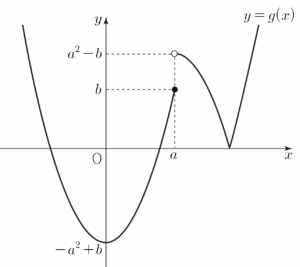
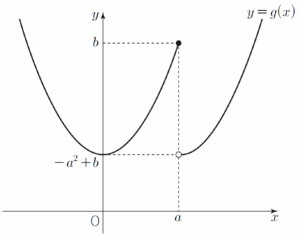
$f(x) = (x-a)^{2}-a^{2}+b$이므로 이차함수 $y = f(x)$의 그래프의 꼭짓점의 좌표는 $(a, -a^{2}+b)$
$f(x+a) = x^{2}-a^{2}+b$이므로 이차함수 $y = f(x+a)$의 그래프의 꼭짓점의 좌표는 $(0, -a^{2}+b)$이고 $g(a) = f(2a) = b$

(ⅰ) $a^{2}-b \le 0$일 때
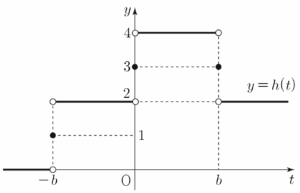
$-a^{2}+b \ge 0$이므로 두 함수 $y = g(x)$, $y = h(t)$의 그래프의 개형은 다음과 같다.
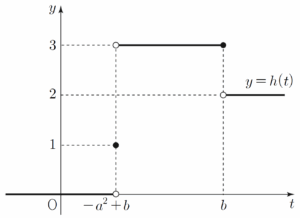
$t \gt b$일 때 $h(t)-2 = 0$이고
$t \lt -a^{2}+b+k$일 때 $h(t-k) = 0$이다.
(a) $k \gt a^{2}$일 때
모든 실수 $t$에 대하여 $\{ h(t)-2 \}h(t-k) = 0$이므로 함수 $\{ h(t)-2 \}h(t-k)$는 실수 전체의 집합에서 연속이다.
(b) $k = a^{2}$일 때
$\{ h(t)-2 \}h(t-k) = \begin{cases} 0 & (t \ne b) \\ 1 & (t = b) \end{cases}$이므로 함수 $\{ h(t)-2 \}h(t-k)$는 $t = b$에서 불연속이다.
(c) $k \lt a^{2}$일 때
$\displaystyle \lim_{t \to b+}\{ h(t)-2 \} = 0$이고 $\displaystyle \lim_{t \to b+}h(t-k) = \alpha_{1}$ ($\alpha_{1} = 2, 3$)이므로
$\displaystyle \lim_{t \to b+}\{ h(t)-2 \}h(t-k) = 0$
한편 $\displaystyle \lim_{t \to b-}\{ h(t)-2 \} = 1$이고 $\displaystyle \lim_{t \to b-}h(t-k) = \beta_{1}$ ($\beta_{1} = 2, 3$)이므로
$\displaystyle \lim_{t \to b-}\{ h(t)-2 \}h(t-k) \ne 0$
그러므로 함수 $\{ h(t)-2 \}h(t-k)$는 $t = b$에서 불연속이다.
(a), (b), (c)에 의해 $k \gt a^{2}$인 임의의 실수 $k$에 대해서만 함수 $\{ h(t)-2 \}h(t-k)$는 실수 전체의 집합에서 연속이다.

(ⅱ) $0 \lt a^{2}-b \lt b$인 경우
두 함수 $y = g(x)$, $y = h(t)$의 그래프의 개형은 다음과 같다.
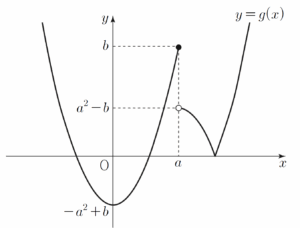
$t \gt b$일 때 $h(t)-2 = 0$이고
$t \lt -a^{2}+b+k$일 때 $h(t-k) = 0$이다.
(a) $k \gt a^{2}$일 때
모든 실수 $t$에 대하여 $\{ h(t)-2 \}h(t-k) = 0$이므로 함수 $\{ h(t)-2 \}h(t-k)$는 실수 전체의 집합에서 연속이다.
(b) $k = a^{2}$일 때
$\{ h(t)-2 \}h(t-k) = \begin{cases} 0 & (t \ne b) \\ 1 & (t = b) \end{cases}$이므로 함수 $\{ h(t)-2 \}h(t-k)$는 $t = b$에서 불연속이다.
(c) $k \lt a^{2}$일 때
$\displaystyle \lim_{t \to b+}\{ h(t)-2 \} = 0$이고 $\displaystyle \lim_{t \to b+}h(t-k) = \alpha_{2}$ ($\alpha_{2} = 2, 3, 4$)이므로
$\displaystyle \lim_{t \to b+}\{ h(t)-2 \}h(t-k) = 0$
한편 $\displaystyle \lim_{t \to b-}\{ h(t)-2 \} = 1$이고 $\displaystyle \lim_{t \to b-}h(t-k) = \beta_{2}$ ($\beta_{2} = 2, 3, 4$)이므로
$\displaystyle \lim_{t \to b-}\{ h(t)-2 \}h(t-k) \ne 0$
그러므로 함수 $\{ h(t)-2 \}h(t-k)$는 $t = b$에서 불연속이다.
(a), (b), (c)에 의해 $k \gt a^{2}$인 임의의 실수 $k$에 대해서만 함수 $\{ h(t)-2 \}h(t-k)$는 실수 전체의 집합에서 연속이다.

(ⅲ) $a^{2}-b = b$인 경우
두 함수 $y = g(x)$, $y = h(t)$의 그래프의 개형은 다음과 같다.
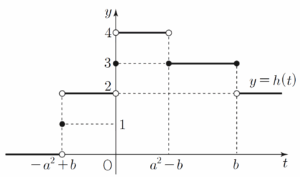
$t \gt b$일 때 $h(t)-2 = 0$이고
$t \lt -b+k$일 때 $h(t-k) = 0$이다.
(a) $k \gt 2b$일 때
모든 실수 $t$에 대하여 $\{ h(t)-2 \}h(t-k) = 0$이므로 함수 $\{ h(t)-2 \}h(t-k)$는 실수 전체의 집합에서 연속이다.
(b) $k = 2b$일 때
$\{ h(t)-2 \}h(t-k) = \begin{cases} 0 & (t \ne b) \\ 1 & (t = b) \end{cases}$이므로 함수 $\{ h(t)-2 \}h(t-k)$는 $t=b$에서 불연속이다.
(c) $k \lt 2b$일 때
$\displaystyle \lim_{t \to b+}\{ h(t)-2 \} = 0$이고 $\displaystyle \lim_{t \to b+}h(t-k) = \alpha_{3}$ ($\alpha_{3} = 2, 4$)이므로
$\displaystyle \lim_{t \to b+}\{ h(t)-2 \}h(t-k) = 0$이다.
한편 $\displaystyle \lim_{t \to b-}\{ h(t)-2 \} = 2$이고 $\displaystyle \lim_{t \to b-}h(t-k) = \beta_{3}$ ($\beta_{3} = 2, 4$)이므로
$\displaystyle \lim_{t \to b-}\{ h(t)-2 \}h(t-k) \ne 0$이다.
그러므로 함수 $\{ h(t)-2 \}h(t-k)$는 $t = b$에서 불연속이다.
(a), (b), (c)에 의해 $k \gt 2b$인 임의의 실수 $k$에 대해서만 함수 $\{ h(t)-2 \}h(t-k)$는 실수 전체의 집합에서 연속이다.

(ⅳ) $a^{2}-b \gt b$인 경우
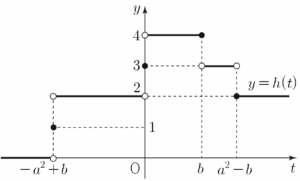
두 함수 $y = g(x)$, $y = h(t)$의 그래프의 개형은 다음과 같다.
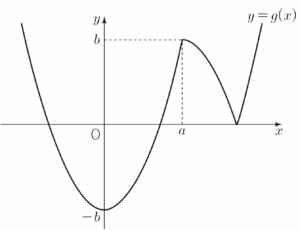
$t \ge a^{2}-b$일 때 $h(t)-2 = 0$이고
$t \lt -a^{2}+b+k$일 때 $h(t-k) = 0$이다.
(a) $k \ge 2(a^{2}-b)$일 때
모든 실수 $t$에 대하여 $\{ h(t)-2 \}h(t-k) = 0$이므로 함수 $\{ h(t)-2 \}h(t-k)$는 실수 전체의 집합에서 연속이다.
(b) $k \lt 2(a^{2}-b)$일 때
$\displaystyle \lim_{t \to (a^{2}-b)+}\{ h(t)-2 \} = 0$이고 $\displaystyle \lim_{t \to (a^{2}-b)+}h(t-k) = \alpha_{4}$ ($\alpha_{4} = 2, 3, 4$)이므로
$\displaystyle \lim_{t \to (a^{2}-b)+}\{ h(t)-2 \}h(t-k) = 0$이다.
한편 $\displaystyle \lim_{t \to (a^{2}-b)-}\{ h(t)-2 \} = 1$이고 $\displaystyle \lim_{t \to (a^{2}-b)-}h(t-k) = \beta_{4}$ ($\beta_{4} = 2, 3, 4$)이므로
$\displaystyle \lim_{t \to (a^{2}-b)-}\{ h(t)-2 \}h(t-k) \ne 0$이다.
그러므로 함수 $\{ h(t)-2 \}h(t-k)$는 $t = a^{2}-b$에서 불연속이다.
(a), (b)에 의해 $k \lt 2(a^{2}-b)$인 임의의 실수 $k$에 대해서만 함수 $\{ h(t)-2 \}h(t-k)$는 실수 전체의 집합에서 연속이다.

(ⅰ)~(ⅳ)에서 조건을 만족시키는 경우는 (ⅳ)이므로
$2(a^{2}-b) = 24$
$a^{2}-b = 12$에서 $b = a^{2}-12 \gt 0$이므로 $a^{2} \gt 12$
$a^{2}-b \gt b$에서 $\begin{align}a^{2}-2b &= a^{2}-2(a^{2}-12) \\ &= 24-a^{2} \gt 0 \end{align}$
이므로 $a^{2} \lt 24$
그러므로 $12 \lt a^{2} \lt 24$
$a$는 자연수이므로 $a = 4$, $b = 4$
따라서 $10a+b = 44$

위로 스크롤